A geomembrane welding machine bonds overlapping panels of thermoplastic liner or cover membrane into one continuous, watertight barrier. Heat softens both surfaces at the overlap, pressure rollers press them together, and the seam cools into a joint that tensile tests rate at no less than 85 per cent of the base membrane strength. It is the production tool for manufacturers, fabricators and contractors building large-format liners and covers for landfills, reservoirs, mining ponds, irrigation canals and dozens of other containment applications. MM-Tech builds the full set in Shijiazhuang, Hebei: six hot wedge welders from the CX300 to the CX900, the CX1600S hot air welder, two hand extruders for patches and pipe penetrations, and the instruments that let a crew prove a seam before it is buried.
Whether you are evaluating your first machine or adding a second unit to an existing line, this guide covers what drives the purchase decision: welding methods, compatible materials, application requirements, machine configurations, and the criteria that separate the right equipment from the wrong one.
The guide comes from workshop practice rather than catalogue copy. Every figure in it is matched to the current MM-Tech range, so the numbers still hold when the machine arrives on site.
Key Takeaways
• Geomembrane welding machines use hot air or hot wedge fusion to produce seams stronger and faster than sewing or adhesive bonding.
• Hot wedge welders lay a dual-track seam with an enclosed air channel, which is the industry standard for landfill, mining and containment work that has to be pressure-tested.
• Handheld configurations match the machine to membrane thickness, seam geometry and site access, and they put no ceiling on the size of panel that can be welded on site.
• One operator runs a geomembrane welder and holds temperature, speed and pressure constant across a full production shift.
• MM-Tech machines are configurable for HDPE, LDPE, PVC and polypropylene (PP), covering all major liner and cover materials.
Why Geomembrane Welding Machines Matter for Liner Fabricators
Speed and quality are the two numbers that decide whether a fabricator is competitive. Manual sewing or adhesive bonding cannot match the throughput of a geomembrane welder, and neither method produces a seam strong enough for containment work where failure carries real environmental and financial consequences.
An MM-Tech hot wedge welder runs at 0 to 9 m/min on polyethylene liners, including HDPE membrane, a rate that hand methods cannot approach even at the low end of the range. One operator steers the machine along the overlap, and a full shift runs without a material-handling crew.
Beyond speed, consistency matters. A geomembrane welding machine holds temperature, speed and pressure constant for the full length of a seam, which removes the variability that comes with hand welding or manual overlap adjustment. Surface preparation still counts: sheets should be clean and free of debris before welding. Where seam integrity is a compliance requirement, that consistency is not optional. Done correctly, welded seams reach at least 85 per cent of the base membrane strength and can be verified with standard seam tests such as ASTM D6392.
Welding Methods — Hot Air vs Hot Wedge for Geomembranes and Liners
Hot wedge welding is the standard for thick HDPE and for seams that must pass air-channel testing; hot air suits PVC, thinner films and varied seam shapes.
When to Use Hot Air vs Hot Wedge
The decision comes down to three factors: material type, required seam testability and material thickness. Welding thick HDPE or polypropylene for a landfill, a mine or a regulated containment site, hot wedge welding is the correct method. Welding PVC, TPU or lighter thermoplastic film across a range of products, or needing flexibility for varying seam geometry, the hot air plastic welder delivers that versatility.
Both methods produce seams that far exceed the strength and reliability of sewing or adhesive bonding. On demanding containment work, hot wedge welding for geomembranes and liners delivers strong, testable seams suited to landfill, mining and large-scale water containment. The right method is application-dependent, not a universal preference.
Geomembrane Materials: HDPE, LDPE, PVC and PP
Compatible Materials
Geomembrane welding machines are designed to work across all major thermoplastic liner and cover materials. The material drives the choice of welding method, temperature range, speed setting and pressure profile, but the underlying thermoplastic welding process is compatible with every material used in modern liner and cover fabrication. MM-Tech machines are configurable for the full range of thermoplastic geomembrane materials. The following materials are the most common in liner and cover production.
HDPE and LDPE Geomembranes
High-density polyethylene (HDPE) is the dominant material in containment liner applications. It offers exceptional chemical resistance, puncture resistance and a service life measured in decades in covered installations. HDPE is the standard material for landfill liners, mining tailings ponds, heap leach pads and wastewater containment systems. Typical liner thickness for containment applications ranges from 1.0 mm to 2.5 mm, with 1.5 mm being the most common for primary containment.
Low-density polyethylene (LDPE) is more flexible than HDPE and is commonly used for pond liners, agricultural reservoir covers and irrigation canal applications where conformability to irregular surfaces is valuable. LDPE welds readily with hot wedge or hot air methods depending on gauge.
Both materials achieve their highest seam strengths with hot wedge welding and produce air channel seams suitable for non-destructive pressure testing.
PVC Geomembranes
Polyvinyl chloride (PVC) liners are widely used in pond and reservoir applications, decorative water features, canal sealing and floating cover systems. PVC is flexible, cost-effective, and UV-stabilized grades perform well in exposed applications. PVC geomembranes weld well with both hot air and hot wedge methods, with method selection depending on the material gauge and seam geometry required.
PVC covers used on reservoirs, biogas digesters and sewage lagoons are a high-volume application, and the ability to produce custom-sized covers in-house, to exact dimensions, is a direct competitive advantage for fabricators serving these markets.
Polypropylene (PP) and Other Thermoplastics
Polypropylene (PP) liners are used in specific chemical containment and mining applications where the properties of HDPE are not required. PP welds with hot wedge equipment at adjusted temperature and speed parameters.
MM-Tech machines are also compatible with additional thermoplastic materials used in liner and cover applications. If your material is not listed here, confirm compatibility with an MM-Tech applications engineer before specifying equipment.
Where Geomembrane Welding Machines Are Used
Applications
Geomembrane liners and covers are used wherever a flexible, impermeable barrier is needed between a liquid, a gas or a solid and the surrounding environment. This geomembrane containment system underpins environmental protection in landfills, ponds, mining operations and more. The breadth of those applications drives the demand for fabrication equipment that can produce custom-sized products efficiently, to consistent quality, across a wide range of materials.
Each application below carries its own material requirements, seam specifications and production scale, and each of them informs machine selection.
Landfill Liners and Containment Systems
Landfill applications are among the most technically demanding geomembrane use cases. Primary containment liners prevent leachate, the liquid that percolates through waste, from contaminating groundwater; secondary containment liners beneath the primary layer provide a backup barrier. Both must be welded to a standard that supports non-destructive air channel pressure testing.
HDPE at 1.5 to 2.0 mm thickness is the standard specification for landfill liner applications. Hot wedge welding produces the dual-track seam required for ASTM D6392 pressure testing. Covers over landfill cells are fabricated from the same material and welded with the same methods, to contain gas and to manage stormwater on the surface.
In-house fabrication of large-area landfill liners with an hdpe liner welding machine on the panel run cuts material handling and produces continuous, custom-dimensioned panels that reduce field seaming at the installation site.
Reservoirs, Ponds, and Water Containment
A pond liner welding machine and a dam liner welding machine cover the water side of the business: irrigation reservoirs, agricultural ponds, drinking water storage facilities, stormwater retention basins and decorative water features. Material and method vary by application, with HDPE and LDPE for agricultural and industrial ponds and PVC for decorative and lighter-duty containment.
The ability to produce any liner size in a single facility, including unusually shaped products, is the direct advantage of in-house welding over manual or outsourced fabrication.
Mining Tailings Ponds and Heap Leach Pads
Mining applications present two of the most demanding liner specifications in the industry. Tailings pond liners contain the fine-particle waste slurry produced by ore processing, a chemically aggressive, high-volume duty; heap leach pad liners sit beneath ore piles irrigated with acid or alkaline leaching solutions to extract metals.
Both applications require large-area HDPE liners with seams that hold under chemical exposure and physical loading, which is work for an hdpe geomembrane welding machine rather than a general-purpose tool. Single-operator production keeps labour cost in check on remote mine sites, and hot wedge seams support the non-destructive testing documentation that environmental regulators require.
Covers — Floating, Fixed, and Engineered
Geomembrane covers are a distinct product category. A cover sits on top of a contained liquid rather than underneath it, and it carries different seam configuration requirements, different load and exposure conditions and often a different material grade from the liner below.
Floating covers on water treatment reservoirs reduce evaporation, limit algae growth and prevent contamination. Fixed covers on biogas digesters and sewage lagoons contain odours and capture methane. Engineered covers on mine tailings ponds keep rainwater out of the containment system and reduce leachate volume.
The same methods apply to cover fabrication, hot air and hot wedge, and the in-house production advantage is equally significant. A fabricator who can produce a custom-dimensioned floating cover to a client reservoir geometry, in-house and in a single production run, holds a different competitive position from one who depends on outsourced cutting and panel assembly.
Anti-Seepage and Environmental Applications
Beyond the categories above, geomembrane liners and covers serve a wide range of anti-seepage and environmental projects: canal sealing to reduce water loss, water conservancy earthworks, sewage treatment lagoon liners, rooftop waterproofing membranes and chemical storage containment, all of which benefit from in-house geomembrane welding for liners and covers to control labour cost and seam quality.
These applications span a wide range of material types and seam requirements. The MM-Tech range of hot air welders and hot wedge welders in standard handheld versions covers the full spectrum of these production needs.
Six Steps to Specify a Geomembrane Welding Machine
Selecting a machine involves six decisions. Work through them in order and you arrive at a specification that matches your production reality rather than a catalogue page that looks good on paper.
Step 1 — Define Your Material and Thickness
Start with the sheet. HDPE from 0.8 to 4.0 mm is served by hot wedge welding, while LDPE welds with either hot wedge welder or hot air welder depending on gauge. PVC takes both methods, with thicker PVC favouring the wedge welder and thin grades the hot air welder. Polypropylene requires hot wedge welding at adjusted parameters. Where a shop runs several materials, confirm changeover time before the order.
Step 2 — Determine Your Required Output
Output decides whether the machine pays for itself. MM-Tech units weld polyethylene liners at 0 to 9 m/min in the right configuration, but the metric that matters for a business is the square metres of finished liner per shift, which depends on seam spacing, membrane width and available production time. Long straight runs on a single thickness reward a machine set up for speed; mixed detail work rewards nozzle and roller options over top speed.
Step 3 — Assess Product Size and Site Conditions
Handheld welders carry no size ceiling: the machine travels along the overlap, so panel length is limited by the roll and the site rather than by the equipment. What does constrain the work is access and geometry, meaning slope angle, wind, standing water and the reach available at the far side of the seam. Choosing a machine on paper speed alone, without weighing the site, limits production later.
Step 4 — Decide Whether Seam Testability Is Required
Where the application needs non-destructive seam testing, as landfill liners, mining containment and regulated wastewater systems do, specify hot wedge welding with an air channel seam. That method produces the dual-track seam geometry required for ASTM D6392 pressure testing. Where no such requirement applies, such as agricultural pond liners or canal sealing, hot air welding offers more flexibility. When in doubt, specify the wedge welder for the testability and the documentation it leaves behind.
Step 5 — Evaluate Power, Access and Weight
Check the supply before the specification. The CX300 runs on 1400 W and weighs 7 kg; the CX600 and CX700 run on 2100 to 2400 W and weigh 11.5 kg. Slope work, roof work and long carries favour the lighter unit, and the 220 V supply has to be where the work happens rather than at the site gate.
Step 6 — Confirm Support and Training
A geomembrane welding machine is a production asset whose value depends on reliable uptime. Before ordering, confirm operator training, the spares list for heating elements, wedges, nozzles and rollers, and the response time on site issues. MM-Tech ships matched nozzle, roller and spare-part sets with every unit and supports the machines from the factory that builds them.
MM-Tech Geomembrane Welding Machines
MM-Tech builds geomembrane welding machines for liners and covers across the full production scale, from a single handheld unit on a small site to a matched set for a fabricating shop. Every machine in the range follows the same principle: reduce labour, hold throughput and produce seams as strong as the material itself.
The range covers the CX300 (1400 W, 0.5 to 1.5 mm, 7 kg), the CX500L (1800 W, 0.8 to 3.0 mm, 9.5 kg, single-side or both-side feed), the CX500S (1800 W, 16 mm tracks with a 16 mm cavity on a wider frame), the CX600 (2100 W, 0.8 to 4.0 mm), the CX700 (2400 W, 1.0 to 4.0 mm) and the CX900 (1800 W, servo-driven, 0.8 to 3.0 mm). Detail work is covered by the CX1600S hot air welder, the CX800A and CX800B hand extruders for patches and pipe penetrations, and the instruments that prove a seam: the CX-002 air pressure tester, the CX-003 vacuum hood, the CX-7DJ pulse-voltage detector, the PST100 spark tester, the CX-001 coupon cutter and the CX-TEN tensiometer.
Standard Handheld Range
The standard range is built for reliable production performance without a fully automated line. Hot air and hot wedge versions are both available, with adjustable temperature, up to 620 °C on the hot air welder and 450 °C on the hot wedge welder, and adjustable speed and pressure to match the material and the application.
All CX machines share the same build: an aviation-aluminium die-cast frame, CNC-machined bearing seats with IKO needle-roller and NSK deep-groove bearings, an imported heating cartridge, a copper wedge with roughly four times the thermal conductivity of brass, digital display of set and actual temperature and speed, spring-balanced pressure adjustment, and a 50 mm wading limit that lets the machine work in shallow standing water without damage.
Frequently Asked Questions About Geomembrane Welding Machines
What is a geomembrane welding machine?
A precision-built machine that fuses overlapping sheets of thermoplastic liner or cover material into one continuous, impermeable barrier. Heat, delivered by a hot air stream or a heated metal wedge, brings the panel surfaces to melting point, and pressure rollers bond them as the seam cools. The result is a seam as strong as the base material at production speeds that sewing, adhesives and mechanical fasteners cannot match. The sequence runs in four steps: feed two overlapping panels at the correct overlap width with the weld area clear of debris; the heating element raises both surfaces at the weld zone; pressure rollers press the softened faces into one fused seam; the seam cools under roller pressure into a watertight bond.
What is the difference between hot air and hot wedge welding?
Hot air welding softens both overlapping surfaces with a controlled stream of heated air before pressure rollers bond them. It is versatile across material types and suitable for thinner thermoplastic films, PVC and TPU. Hot wedge welding inserts a heated metal element between the panels and heats both surfaces at once; as a hot wedge welding technology it produces a dual-track seam with an enclosed air channel that can be pressure-tested to ASTM D6392, the method required for landfill liners, mining containment and other regulated applications. For thick HDPE and any seam that must be tested, the wedge welder is the standard.
What materials can a geomembrane welding machine weld?
All major thermoplastic liner and cover materials: HDPE, LDPE, PVC and polypropylene, with the method, temperature range and speed parameters adjusted for each. MM-Tech also builds an extrusion welder for patches and thick-section repairs. If your specific material is not listed, confirm compatibility with an MM-Tech applications engineer.
What is an air channel seam and why does it matter?
An air channel seam, also called a dual-track seam, comes from hot wedge welding. The wedge geometry creates two parallel weld tracks with an enclosed air channel running between them. After welding, a pressure gauge is connected to the channel and air is pumped in; if pressure holds through the test period, the seam is confirmed leak-free over its full length without cutting or destroying any of the welded material. This non-destructive test is required for landfill liners, mining containment systems and regulated wastewater applications under standards including ASTM D6392, and it is the main reason the wedge welder is the standard tool for containment liners.
How fast do geomembrane welding machines operate?
Speed depends on material type, gauge and machine configuration. MM-Tech units weld polyethylene liners at 0 to 9 m/min in the right configuration, and PVC liners run slower because of material behaviour. For a shop the practical figure is square metres of finished liner per shift rather than metres per minute, and a consistent speed across the shift matters more than the peak number in a catalogue.
Can one operator run a geomembrane welder?
Yes. The CX series are handheld units of 7 to 11.5 kg steered along the overlap by a single operator, and the digital readout of temperature and speed plus spring-balanced pressure keeps the seam consistent without a second pair of hands. On site the constraint is usually moving the roll, not running the machine.
What machine is best for landfill liners?
An hdpe liner welding machine with a dual-track seam and an air channel, because landfill specifications call for non-destructive pressure testing to ASTM D6392. The CX600 covers 0.8 to 4.0 mm at 2100 W and is the usual answer for a 1.5 mm liner; the CX700 takes the thicker specification and the long slope runs.
About MM-Tech
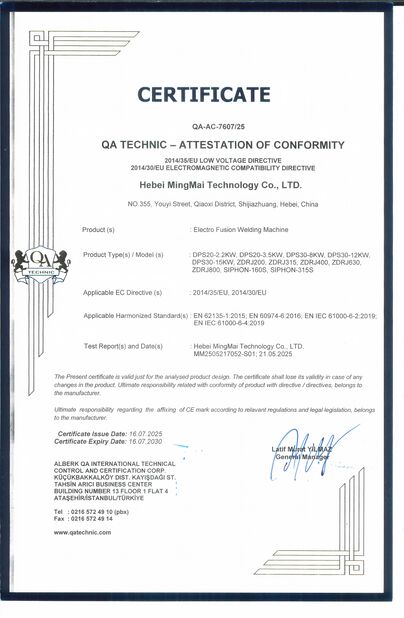
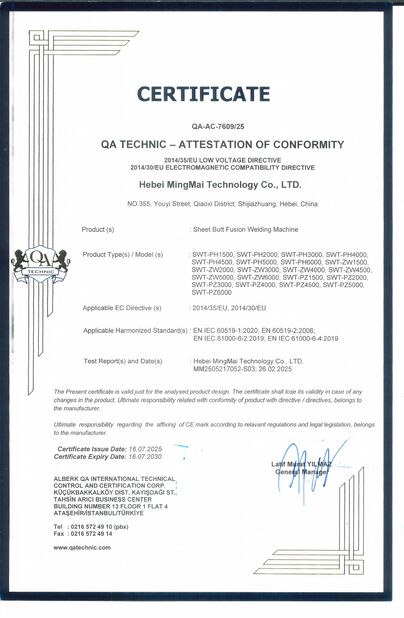
MM-Tech designs and manufactures geomembrane welding machines and hdpe welding machine sets in Shijiazhuang, Hebei, China. The machines carry the CE mark and ship with matched nozzle, roller and spare-part sets, and the test instruments come from the same source, so a crew can weld and verify through one supply chain. Technical enquiries: +86 311 8066 2170, www.hdpeweldingmachine.com.
Send the membrane specification, meaning material, thickness, seam geometry and site conditions, and an MM-Tech engineer will match a machine to it.


 Your message must be between 20-3,000 characters!