Dam liner welding machines create leak-proof seams in geomembrane liners, particularly HDPE, used in dams, reservoirs, ponds, canals and water containment structures. The machines in this review are hot wedge welders: a heated metal wedge melts the overlapping liner edges and pressure rollers fuse them, at seam strengths of at least 85 per cent of the parent material under ASTM D6392.
For large dam and reservoir projects, reliable welding prevents seepage, holds structural integrity and meets environmental requirements. Modern machines offer digital temperature control, variable speed from 0 to 9 m/min, and a build that survives field conditions. This 2026 review ranks six machines on measurable metrics, technical specifications, field performance and value, all built by MM-Tech in Shijiazhuang and shipped with matched rollers, nozzles and test instruments.
Every figure below is matched to the current CX range, so the specification still holds when the machine arrives on site.
1. Why Dam Liner Welding Machines Are Essential
A dam liner needs seam integrity against water pressure, thermal cycling and long exposure. Hot wedge welding is the industry standard for HDPE dam liners from 0.5 to 3.0 mm, because it produces consistent double-track seams with a testable air channel.
Key Performance Metrics
• Welding speed: 0 to 9 m/min, adjustable to liner thickness.
• Temperature: up to 450 °C on hot wedge and 20 to 620 °C on hot air, with digital control of set and actual values.
• Pressure: spring-balanced rollers, adjustable on the handle.
• Seam strength: at least 85 per cent of base material.
• Power: 1400 to 2400 W across the wedge range, 1600 W on hot air.
• Weight: 7 to 11.5 kg for field use, handheld on the hot air side.
• Seam record: an air channel pressure test plus a coupon test, which is what a regulator asks to see.
Proper machine selection, operator training and daily test seams hold defect rates under 1 per cent on critical dam projects.
2. Top 6 Best Dam Liner Welding Machine Review
1. CX600 — Precision Leader for Dam Liners
The CX600 is the benchmark for professional dam liner welding machine work at 1.5 to 2.0 mm.
• Power: 2100 W.
• Temperature: up to 450 °C.
• Speed: 0 to 9 m/min, stepless.
• Weight: 11.5 kg.
• Build: 16 mm double tracks with a 16 mm air channel, 100 mm wedge, 120 mm overlap, digital display of set and actual temperature and speed.
It holds on large reservoirs and dams where the seam record has to stand up to audit, because the air channel gives a pressure test over the full seam length rather than a spot check.
2. CX700 — Heavy-Duty Output for Thick HDPE
The CX700 takes the thick end of the range, where a hot wedge welder has to hold speed under load.
• Power: 2400 W.
• Temperature: up to 450 °C.
• Range: 1.0 to 4.0 mm HDPE, with a 120 mm wedge.
• Weight: 11.5 kg.
Ideal for mining tailings dams and large water containment, where the liner runs to 3 mm and the seam runs are long.
3. CX500S — Compact and Precise for Versatile Sites
The CX500S suits contractors who move between sites and work a slope without a second pair of hands.
• Power: 1800 W.
• Range: 0.8 to 3.0 mm.
• Build: 16 mm tracks with a 16 mm cavity on a wider frame, 110 mm overlap.
• Weight: 10 kg.
• Adjustment: stepless setting of temperature, speed and pressure.
The wide frame keeps the wedge welder stable on textured liner and on the curve of a reservoir corner, which is where a narrow machine drifts.
4. CX900 — Servo Drive for Thick Liners
The CX900 holds heat and travel speed steady on long runs, which is the difference between a consistent seam and a variable one.
• Power: 1800 W.
• Range: 0.8 to 3.0 mm.
• Control: PID constant temperature, PWM speed stabilisation and a DC servo drive.
• Weight: 11 kg.
• Display: digital readout of set and actual temperature and speed.
Reliable performance in civil and water projects on 1.0 to 3.0 mm liner, where the crew has to hold the same parameters from the first seam to the last.
5. CX1600S and CX800A/B — Detail and Repair Tools
The seams a wedge cannot reach need a different machine, and this is the pair that covers them: a hot air welder for thin film and detail, and hand extruders for thick-section patches.
• CX1600S: 1600 W, 20 to 620 °C through a digital controller, 160 L/min, with 20 and 40 mm slot nozzles, a 5 mm tubular nozzle for pipe and penetration work, angle nozzles and rollers from 20 to 90 mm.
• CX800A: 800 W auger at 2 to 2.5 kg/h on 3 to 5 mm rod. CX800B: 1300 W auger at 2 to 3 kg/h on 3 to 4 mm rod.
• Coverage: 1 to 20 mm material, which takes in T-joints, pipe boots, valve surrounds, patches and field damage.
A dam project usually needs both: the wedge for the main runs, and this pair for the corners, the penetrations and the repairs found during the leak survey.
6. CX300 — Light Entry Machine for Small Ponds
The CX300 covers the small end: ponds, canal lining, aquaculture tanks and landfill cover work.
• Power: 1400 W.
• Range: 0.5 to 1.5 mm.
• Build: 15 mm tracks with a 12 mm cavity, 100 mm overlap.
• Weight: 7 kg, feeding from one side or both sides.
Seven kilograms on the handle counts for more than another kilowatt when the machine has to follow the curve of a tank, and the machine still leaves a cavity that can be pressure-tested.
3. Matching the Machine to the Liner
A smooth or textured HDPE liner welds well when thickness and surface quality stay consistent, and the machine has to be specified against the liner rather than bought on price alone.
• The CX600 and CX700 hold seam strength at 85 per cent of base material or better on 1.5 to 2.0 mm HDPE.
• Wide roll widths cut the number of seams a large dam needs, which is where labour cost sits.
• An air channel test gives a full-length record rather than a spot check, which is what a compliance file needs.
• Test instruments from the same supply chain mean the crew welds and verifies without a second vendor.
• Machine and liner specified together keep the project inside ASTM D6392 rather than at the edge of it.
Machine and liner are one decision, not two. A machine that cannot hold its parameters, or a liner with inconsistent gauge, will show up as a failed seam on the test record rather than on the invoice.
Conclusion
Dam liner welding machines decide whether a containment structure holds. The CX600 and CX700 set the standard for precision and heavy-duty work, the CX500S and CX900 cover mixed sites and long runs, and the CX1600S with the CX800A/B pair covers everything the wedge cannot reach.
Invest in operator training, regular maintenance, daily test seams and machine calibration, and pair a quality liner with a machine that can hold its parameters. For machine selection, spares or a trial on your own liner, contact MM-Tech: +86 311 8066 2170, www.hdpeweldingmachine.com.
About MM-Tech
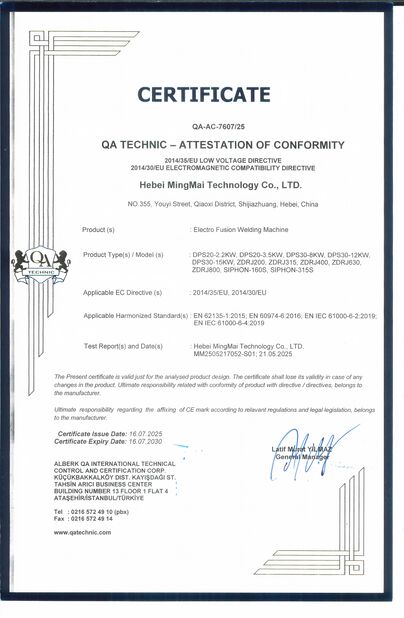
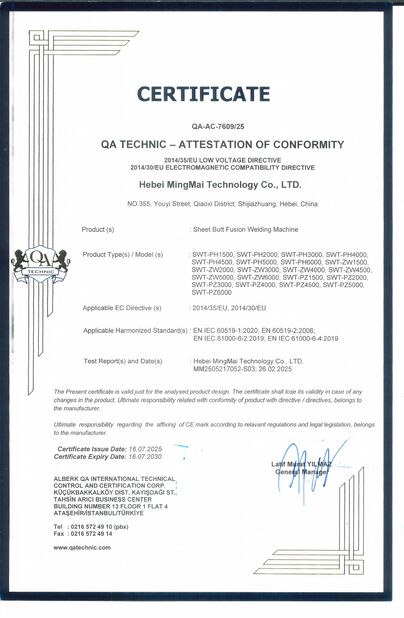
MM-Tech designs and manufactures geomembrane welding machines in Shijiazhuang, Hebei, China. The machines carry the CE mark and ship with matched nozzle, roller and spare-part sets, and the test instruments come from the same source, so a crew can weld and verify through one supply chain.


 Your message must be between 20-3,000 characters!